Theories: Maslow, Gardner, Bloom and Dewey
Some theories are not easy to be used in education, such as Maslow's Hierarchy of Needs, but some of them are fabulous for a teacher to treat students with different ways such as Gardner's Multiple Intelligences and Dewey's Education Philosophy.
Like what Mr. Brown said, the theories and the humans just like a "stool" which will not stand if one of these does not exit.
Indeed, there are still numerous theories about education. How to integrate these theories with education is the abilities of teachers.
And I think I can do it better and better.
Like what Mr. Brown said, the theories and the humans just like a "stool" which will not stand if one of these does not exit.
Indeed, there are still numerous theories about education. How to integrate these theories with education is the abilities of teachers.
And I think I can do it better and better.
Maslow's Hierarchy of Needs

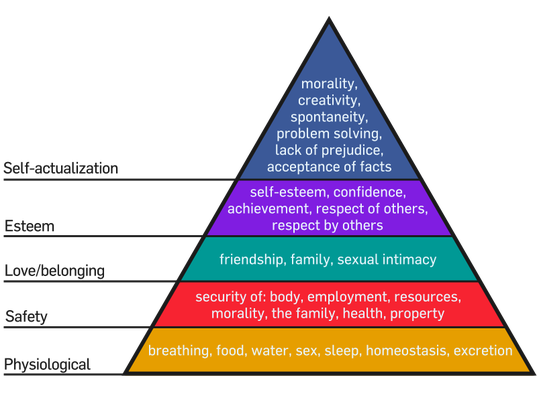
Why a teacher has to know the hierarchy? It's about psychology, not about education.
In my opinion, education is to fulfill humans' esteem and self-actualization. Through education, we can be more creative, positive and active. When we achieve the top actualization, not only benefit ourselves but also this world.
In my opinion, education is to fulfill humans' esteem and self-actualization. Through education, we can be more creative, positive and active. When we achieve the top actualization, not only benefit ourselves but also this world.
Gardner's Multiple Intelligences
http://en.wikipedia.org/wiki/Theory_of_multiple_intelligences
The theory's eight currently accepted intelligences are: (Ref: Educational Psychology, Robert Slavin. 2009, 117)
I learned this theory several years ago, but I never realize the main purpose why I had to learn this.
In Taiwan, we still focus on pen and paper test. If you do not get a good grades, you are not a good students.
It's our tradition but it's also our heavy loads. I am glad that I was so lucky that I could get good grades most of the time.
Now I am a teacher, as my educational philosophy, no matter students get good or bad grades, I know they have their own intelligences and gifts.
Hope this theory can be widely planned in teachers' and parents' mind.
- Spatial
- Linguistic
- Logical-mathematical
- Bodily-kinesthetic
- Musical
- Interpersonal
- Intrapersonal
- Naturalistic
I learned this theory several years ago, but I never realize the main purpose why I had to learn this.
In Taiwan, we still focus on pen and paper test. If you do not get a good grades, you are not a good students.
It's our tradition but it's also our heavy loads. I am glad that I was so lucky that I could get good grades most of the time.
Now I am a teacher, as my educational philosophy, no matter students get good or bad grades, I know they have their own intelligences and gifts.
Hope this theory can be widely planned in teachers' and parents' mind.
Bloom's Texonomy
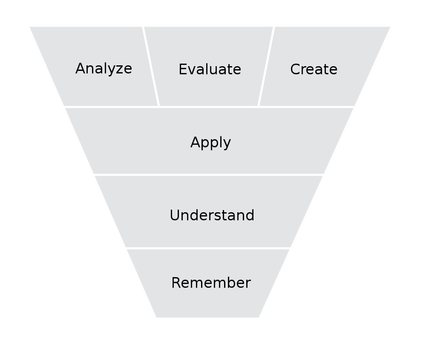
Remember-Knowledge
Understand-Comprehension
Apply-Application
Analyze-Analysis
Evaluate-Evaluation
Create
Synthesis
Understand-Comprehension
Apply-Application
Analyze-Analysis
Evaluate-Evaluation
Create
Synthesis
There are six levels in the taxonomy, moving through the lowest order processes to the highest:
Knowledge
Comprehension
Application
Analysis
Synthesis
Evaluation
Knowledge
Comprehension
Application
Analysis
Synthesis
Evaluation
John Dewey's Education Philosophy
Educational philosophy Dewey applied most of his thought and energy in the area of education reform. In Democracy and Education, Dewey attempts to, at once, synthesize, criticize, and expand upon the democratic or proto-democratic educational philosophies of Rousseau and Plato. He saw Rousseau as overemphasizing the individual and Plato as overemphasizing the society in which the individual lived. For Dewey, this distinction was, by and large, a false one; like Lev Vygotsky, he viewed the mind and its formation as communal process. Thus, the individual is only a meaningful concept when regarded as an inextricable part of his or her society, and the society has no meaning apart from its realization in the lives of its individual members. However, as evidenced in his later Experience and Nature, Dewey recognizes the importance of the subjective experience of individual people in introducing revolutionary new ideas.
As a pragmatist, Dewey felt it was vitally important that education not be the teaching of mere dead fact but that the skills and knowledge that students learn be integrated fully into their lives as persons, citizens, and human beings. At the Laboratory Schools that Dewey and his wife Alice ran at the University of Chicago, children learned much of their early chemistry, physics, and biology by investigating the natural processes that went into cooking breakfast—an activity they did in their classes. Dewey firmly held that one does not learn solely through memorization of theories and facts, but through experience. Thus he coined the term “learning by doing.”
His ideas were quite popular but were never really integrated into the practices of American public schools, though some of his values and terms were widespread. Progressive education (both as espoused by Dewey, and in the more popular and inept forms of which Dewey was critical) was essentially scrapped during the Cold War, when the dominant concern in education was creating and sustaining a scientific and technological elite for military purposes. In the post-Cold War period, however, progressive education has reemerged in many school reform and education theory circles as a thriving field of inquiry.
As a pragmatist, Dewey felt it was vitally important that education not be the teaching of mere dead fact but that the skills and knowledge that students learn be integrated fully into their lives as persons, citizens, and human beings. At the Laboratory Schools that Dewey and his wife Alice ran at the University of Chicago, children learned much of their early chemistry, physics, and biology by investigating the natural processes that went into cooking breakfast—an activity they did in their classes. Dewey firmly held that one does not learn solely through memorization of theories and facts, but through experience. Thus he coined the term “learning by doing.”
His ideas were quite popular but were never really integrated into the practices of American public schools, though some of his values and terms were widespread. Progressive education (both as espoused by Dewey, and in the more popular and inept forms of which Dewey was critical) was essentially scrapped during the Cold War, when the dominant concern in education was creating and sustaining a scientific and technological elite for military purposes. In the post-Cold War period, however, progressive education has reemerged in many school reform and education theory circles as a thriving field of inquiry.